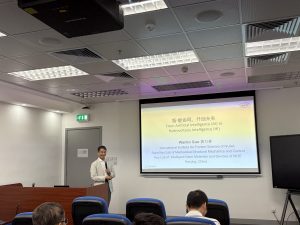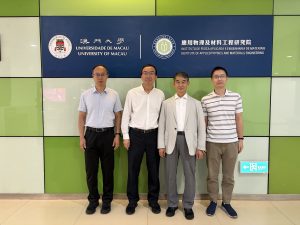
Our institute recently hosted a seminar entitled “From artificial intelligence (AI) to Hydrovoltaic Intelligence (HI)” on 7th May, delivered by Prof. Wanlin Guo, from Nanjing University of Aeronautics and Astronautics (NUAA). The seminar was hosted by Prof. Qibing Pei.
Prof. Guo is an Academician of the Chinese Academy of Sciences, a Professor at Nanjing University of Aeronautics and Astronautics, and the Dean of the International Institute for Fronties Science. Prof. Guo has long been engaged in research on digital science and intelligent technology for aerospace, hydrovoltaic science and technology, and physical mechanics. His current research focuses on hydrovoltaic energy, ecology and intelligence; quantum biophysical mechanics; intelligent nanomaterials and devices; and structural strength, durability and reliability. In 2012 and 2024, he twice received the Second Prize of the National Natural Science Award of China as the leading recipient. In 2013, he received the Xu Zhilun Mechanics Prize. In 2019, he was awarded the Ho Leung Ho Lee Foundation Prize for Scientific and Technological Progress and the Eric Reissner Award in International Mechanics. In 2020, he was honored with the title of National Advanced Worker. Prof. Guo published more than 700 papers with more than 30,00 citations.
In this talk, Prof. Guo compared natural intelligence (NI) and artificial intelligence (AI) in term of energy consumption. He found that the AI requires enormous amount of energy, 9 order higher than NI, i.e. human brains. He pointed out that the neuron based intelligence increases bi-exponentially with increased number of neurons if they connected in three dimensional sphere. The simulation did by his team found that the neurons work with energy cost only about 1.26 times of theoretical limit – landau limit. His work explained the need to improve AI in energy efficiency is important to simulate brain working.
In the following section, Prof. Guo also discussed the importance of proton ions kinetics in liquid water. He pioneered the explanation of hyperfast proton ion transfer due to tunneling of proton with help of water molecules. His team also used the interesting kinetics of proton in water and discovered evaporation potential, rubber potential due to the simple evaporation and movement of liquid water to general electricity directly, which has great potential to work together with current green energy harvesting methods like photovoltaics. He also highlight the potential of energy storage application from his discoveries.
In conclusion, Prof. Guo suggested us to learn from the nature and study natural phenomena closely and to really learn to “think”. Following that, a short campus tour was offered to Prof. Guo a deeper understanding of UM’s history and development.