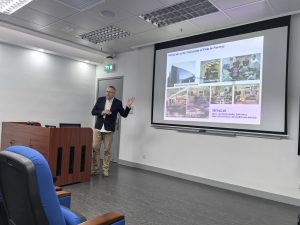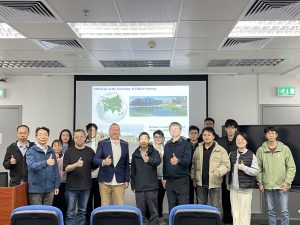
On 9 Jan 2026, Prof. Andrej KUZNETSOV (安德烈・庫茲涅佐夫教授), from the Department of Physics, University of Oslo, visited IAPME and delivered an insightful lecture titled “Quantum initiatives in Norway and discovery of polymorph heterostructures”, chaired by Prof. Shuangpeng Wang. The presentation focused on the novel strategy on heterostructure construction, sparking engaging discussions among attending faculty and students.
Prof. Andrej Kuznetsov is a leading scholar in semiconductor physics and nanotechnology, enjoying an international reputation, particularly for his research on wide-bandgap semiconductors (such as gallium oxide, Ga₂O₃), radiation effects, and novel semiconductor materials and devices. He was awarded with a Ph.D. degree in physics from the Russian Academy of Sciences in 1992 and accomplished his habilitation in solid state electronics in 2000 at the Royal Institute of Technology in Sweden. In 2001 he joined the University of Oslo in Norway as an Associate Professor at the Department of Physics, where he was subsequently promoted to a full Professor rank in 2003. From 2018 he acts as the Chair of the Centre of Excellence: Light and Electricity from Novel Semiconductors (LENS) as a part of the Centre for Mate rials Science and Nanotechnology at UiO. The focus is to understand novel semiconductors, searching for new fundamental phenomena and enabling new device functionalities.
During his lecture, Prof. Kuznetsov began by outlining Norway’s quantum technology efforts, emphasizing the establishment of the Centre for Defects in Semiconductors for Quantum Sensing (DSQS), active from 2025 to 2030. This initiative aims to bridge fundamental science and applications, fostering national and international collaborations. Then Prof. Kuznetsov recalled the contribution and development of semiconductor heterostructures, and then introduced the novel concept of polymorph heterostructures, which combine different crystalline forms of the same material (e.g., gallium oxide polymorphs) to create atomically sharp interfaces. The challenge of conventional methods—prone to degradation due to temperature or pressure changes—was addressed through disorder-assisted epitaxy, a technique using ion irradiation to induce controlled phase transitions. The discovery of disorder-induced ordering in Ga₂O₃, where increased disorder paradoxically leads to crystallization instead of amorphization, resulting in unprecedented radiation tolerance.
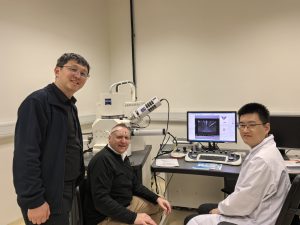
Following the presentation, Prof. Kuznetsov toured IAPME labs, engaged in detailed discussions with researchers and students, and explored potential collaborative projects. The visit was hosted by Prof. Shuangpeng Wang who extended the invitation to Prof. Kuznetsov.