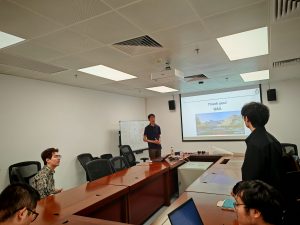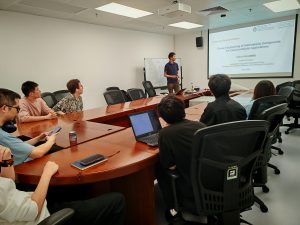
The Institute recently hosted a seminar titled “Phase Engineering of Intermetallic Compounds for Electrocatalytic Applications” on April 10, presented by Prof. Qinbai Yun from The Hong Kong University of Science and Technology (Guangzhou), and the seminar was hosted by Prof. Qing Li.
Prof. Qinbai Yun is an Assistant Professor in the Sustainable Energy and Environment Thrust at HKUST (Guangzhou). He received his B.E. and M.E. degrees from Tsinghua University and his Ph.D. from Nanyang Technological University, Singapore. He subsequently worked as a Postdoctoral Fellow and Research Assistant Professor at City University of Hong Kong and The Hong Kong University of Science and Technology, respectively. His research focuses on the precise synthesis of low-dimensional metallic materials for electrochemical energy conversion and electrosynthesis of fine chemicals. To date, he has published 77 academic papers, including 25 as (co-)first or corresponding author in leading journals such as Chem. Rev., Adv. Mater., Angew. Chem. Int. Ed., J. Am. Chem. Soc., Adv. Funct. Mater., and ACS Nano. He has been recognized as one of the “World’s Top 2% Scientists” (Stanford University, 2024–2025) and is a recipient of the Chinese Government Award for Outstanding Self-Financed Students Abroad.
In his presentation, Prof. Yun introduced phase engineering strategies for intermetallic compounds (IMCs), highlighting their potential as highly efficient electrocatalysts due to their well-defined active site configurations and structural stability. He discussed the challenges in precisely modulating active sites for targeted catalytic reactions and presented innovative approaches to address this issue. By employing high-temperature annealing methods, his team achieved the controlled synthesis of IMC nanomaterials with tunable electronic structures, demonstrating excellent performance in nitrate reduction and water splitting. Furthermore, he showcased wet-chemical synthesis strategies for Pd-based IMCs with tailored morphologies, where the synergistic regulation of crystal phase and morphology significantly enhanced alcohol oxidation activity. He also introduced heterophase IMC systems, including amorphous/IMC and alloy/IMC structures, where interfacial effects and phase boundaries contributed to improved catalytic performance.
The seminar concluded with an engaging discussion session. Students and researchers actively interacted with Prof. Yun, exchanging ideas on phase engineering strategies and their broader implications for electrocatalysis. The event provided an excellent platform for academic exchange and left the audience with a deeper understanding of advanced catalyst design.