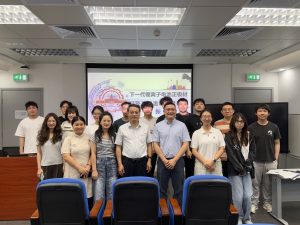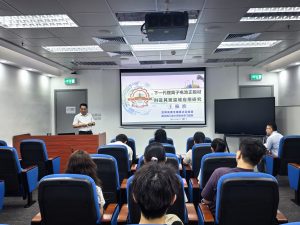
On April 14, 2026, Prof. Zhenbo Wang delivered an invited seminar titled “Design and Failure Regulation Mechanisms of High-EnergyDensity Batteries under Extreme Operating Conditions.” The seminar was hosted by Prof. Kwun Nam Hui. Prof. Wang is a tenured Professor and Ph.D. supervisor at Harbin Institute of Technology and a Foreign Member of the Russian Academy of Engineering. He is widely recognized for his contributions to energy storage materials and their engineering applications, particularly in lithium-ion, sodium-ion, and hydrogen energy systems. He has published over 350 SCI-indexed papers in leading journals, including Nature Catalysis, Nature Communications, Advanced Materials, and Angewandte Chemie International Edition, with an H-index of 75, and has been listed as an Elsevier Highly Cited Chinese Researcher for 12 consecutive years.
Prof. Wang opened his talk by highlighting the growing demand for high-power traction batteries and energy storage systems capable of operating across a wide temperature range. He emphasized that achieving both high energy density and robust performance under extreme conditions remains a critical challenge, largely due to complex structural degradation and interfacial instability in cathode materials. To address these issues, he introduced a research framework centered on structural–interfacial synergistic regulation, supported by advanced characterization techniques and multiscale analytical approaches to systematically track degradation evolution and guide materials design.
Focusing on representative cathode systems, Prof. Wang first discussed LiNi₀.₅Mn₁.₅O₄ (LNMO), where his team improves structural tolerance through morphology control, grain-boundary stabilization, and defect–interface coupling, effectively suppressing parasitic side reactions. At the device level, Prof. Wang highlighted the importance of co-optimizing electrolytes and manufacturing processes. His team conducts rigorous validation under extreme operating conditions, including ultra-high temperature, ultra-low temperature, and ultra-high power scenarios, demonstrating the practical viability of these materials in applications such as unmanned aerial vehicles, electric vehicles, and large-scale energy storage systems.
In conclusion, Prof. Wang proposed a closed-loop research paradigm integrating characterization, mechanism understanding, materials design, and full-cell validation. This comprehensive approach provides a clear methodological pathway to accelerate the industrialization of next-generation cathode materials and underscores the importance of bridging fundamental science with real-world applications.