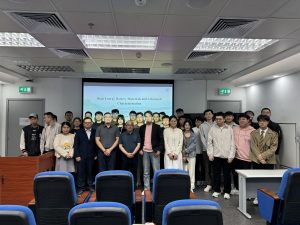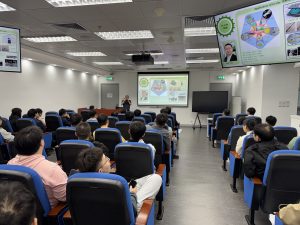
On December 1, 2025, Prof. Jun Lu (陸俊) delivered an invited seminar titled “High Energy Battery Materials and Advanced Characterization” The seminar was hosted by Prof. Kwun Nam Hui. Prof. Lu is a distinguished researcher in battery materials and synchrotron-based diagnostics, widely recognized for his pioneering work on structural degradation mechanisms in layered oxide cathodes. He has published extensively in leading journals and has made significant contributions to the understanding and optimization of high-energy-density electrode materials.
Prof. Lu opened his talk by emphasizing the accelerating demand for high-performance lithium-ion batteries driven by the rapid development of new energy vehicles and large-scale storage systems. These emerging applications require cathode materials with higher energy density and longer cycle life; however, he pointed out that unclear failure mechanisms in existing materials continue to limit their practical advancement. To address this knowledge gap, his team conducted a comprehensive investigation of performance degradation in layered cathode materials using a suite of advanced synchrotron radiation characterization techniques capable of capturing structural evolution under realistic operating conditions technologies.
A major highlight of the seminar was Prof. Lu’s breakthrough discovery of a fundamental link between local stress–strain accumulation and the formation of lattice microcracks in layered cathodes. He explained that lithium intercalation and deintercalation induce localized stress concentrations, which in turn cause structural distortion, crack initiation, and long-term capacity fading. This mechanistic insight resolves a long-standing scientific challenge regarding the intrinsic origin of structural degradation in high-energy cathode materials.
The seminar concluded with a lively and insightful Q&A session, during which attendees discussed topics such as operando characterization, stress-regulation design principles, and future directions for cathode innovation. Prof. Lu’s visit strengthened research exchange and highlighted a shared commitment to advancing the science of high-energy-density battery materials through cutting-edge characterization and mechanism-driven design.