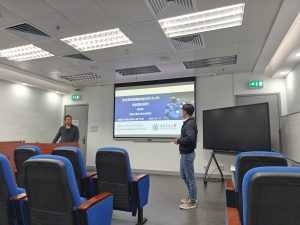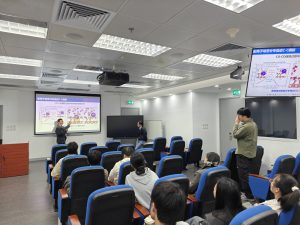
On January 21, 2026, in a timely seminar addressing the global push for sustainable energy, Prof. Yaqiong Su (蘇亞瓊) of Xi’an Jiaotong University delivered an insightful presentation on “Multi-Scale Modeling of Electrochemical CO2RR”, the session was hosted by Prof. Hui Pan. The event drew researchers, students, and faculty eager to explore cutting-edge solutions for carbon capture and utilization.
The lecture delved into the electrochemical reduction of carbon dioxide (eCO2RR), a promising technology for converting greenhouse gases into valuable fuels and chemicals. Prof. Su, a renowned expert in theoretical chemistry and computational catalysis, unpacked the atomic-level mysteries of eCO2RR mechanisms at the catalyst-electrolyte interface, a frontier that remains poorly understood despite its potential to drive carbon neutrality.
Prof. Yaqiong SU received his Master degree from Xiamen University and PhD degree from Eindhoven University of Technology. He is now a Distinguished Professor and Principal Investigator at School of Chemistry, Xi’an Jiaotong University. His research involves theoretical chemistry, computational catalysis and spectroscopic electrochemistry.
“While eCO2RR holds immense promise, the dynamic interplay between active sites and the surrounding chemical environment under real reaction conditions has been elusive,” Prof. Su explained during his talk. Leveraging constant-potential simulations and molecular dynamics modeling, he illustrated how these tools reveal the evolution of active sites and their impact on reaction performance. A key highlight was his revelation of the “activity origin” for producing C2+ products, which are critical for industrial scalability. Prof. Su emphasized the pivotal role of intermediate CO coverage in steering product selectivity, offering a blueprint for designing more efficient catalysts.
The presentation also introduced an innovative coarse-grained modeling framework to assess how electrolyte mass transfer influences electrochemical outcomes. Attendees were particularly struck by visualizations from Prof. Su’s models, which bridged microscopic atomic behaviors to macroscopic performance metrics, underscoring the need for integrated multi-scale approaches in green chemistry.
Prof. Su’s distinguished career lent added weight to the discussion. A lively Q&A session, finished with participants probing applications in renewable energy storage and industrial decarbonization. Prof. Pan praised the talk’s relevance: “In an era of climate urgency, Prof. Su’s work provides the theoretical backbone for practical innovations that could transform Macau’s role in Asia’s green economy.”